
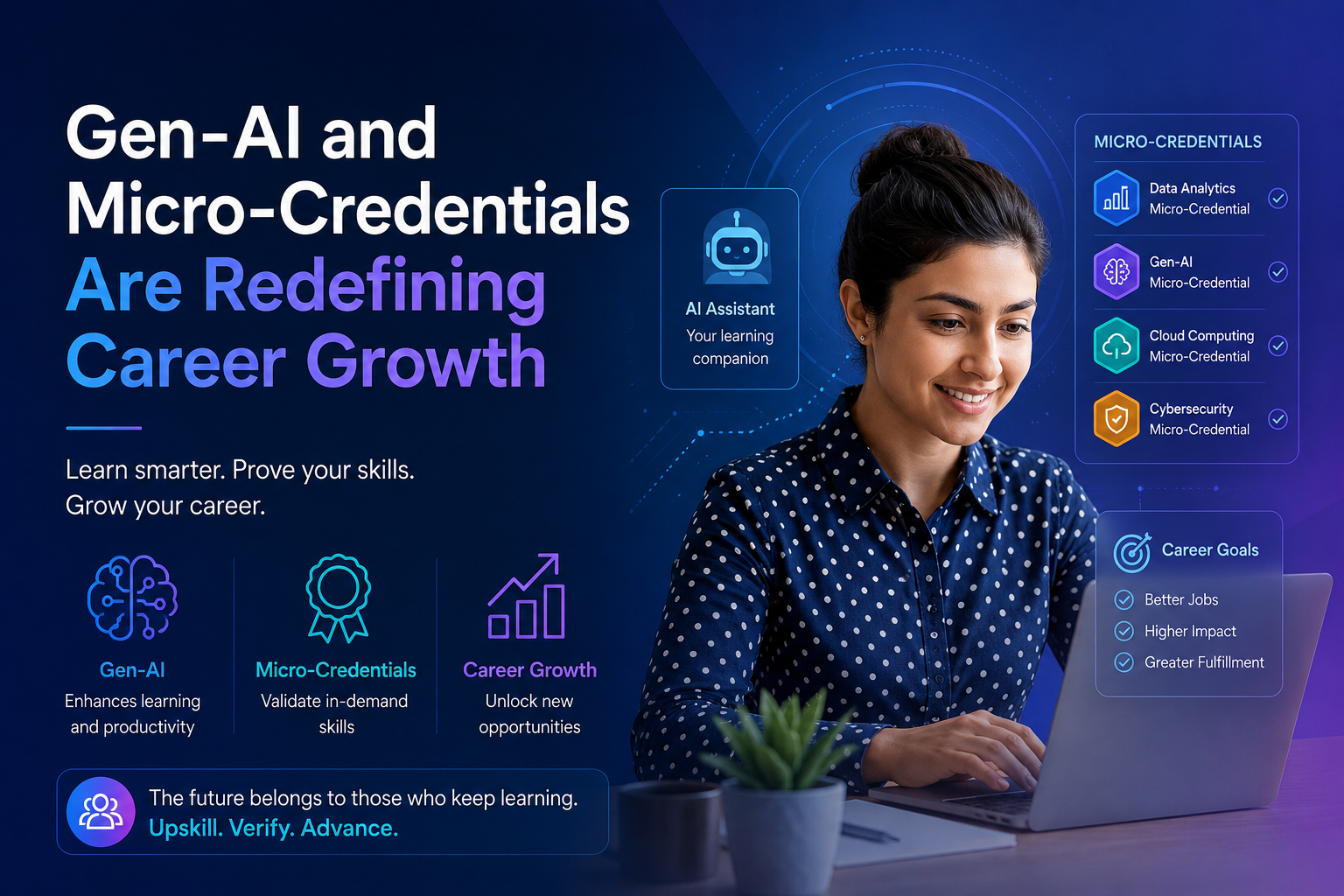
The relationship between education and employment is changing faster than many institutions expected. Traditional degrees still matter, but employers increasingly want proof of specific, job-ready skills. At the same time, generative AI is transforming workplaces, creating demand for workers who can adapt quickly and learn continuously. This shift has pushed micro-credentials from a niche concept into a major force in modern education. Research shows that students and professionals are now turning to shorter, targeted learning pathways to stay competitive in an AI-driven economy.
Recent discussions across industry publications and education platforms have highlighted the same trend. Articles on emerging micro-credential ecosystems point to growing demand for flexible learning options that align directly with workplace needs. The focus is no longer just on what people know. It is increasingly about what they can demonstrate and apply in real-world situations.
Why Skills-Based Learning Is Replacing Traditional Models
Skills-based learning focuses on measurable competencies rather than time spent in a classroom. Instead of completing a multi-year program before entering the workforce, learners can acquire targeted expertise in areas such as cybersecurity, data analytics, project management, and AI applications.
This trend is especially visible in the United States, where millions of credentials now exist across universities, training providers, professional organizations, and online platforms. The ecosystem is vast, giving learners many opportunities but also creating confusion about quality and recognition.
Australia has taken a different approach. Through its national framework, micro-credentials can often connect directly to formal qualifications, making it easier for students to understand how short courses contribute to long-term educational goals. The result is a more structured pathway between skill development and academic achievement.
As discussed in articles such as Micro-Credentials, Gen-AI & The Future of Skills-Based Learning and Emerging Trends in Micro-Credentials and Gen-AI Skills, educational systems are increasingly recognizing that lifelong learning must be flexible, stackable, and responsive to labor market changes.
The Growing Demand for Gen-AI Skills
Generative AI has created a new category of workplace skills almost overnight. Organizations now seek employees who understand prompt design, AI-assisted workflows, data interpretation, digital ethics, and AI governance.
The research highlights that a large majority of students view AI literacy as essential for future career success. Interest in short AI-focused credentials has risen sharply as learners recognize that AI knowledge is becoming valuable across nearly every industry.
Think of AI skills today the way spreadsheet skills were viewed in the 1990s. At one time, knowing how to use spreadsheet software offered a competitive advantage. Eventually it became a basic workplace expectation. AI literacy appears to be following a similar path, but at a much faster pace.
This shift explains why education providers are rapidly developing specialized programs around artificial intelligence. The popularity of industry-recognized certificates demonstrates that learners want practical outcomes rather than purely theoretical instruction.
For students trying to build expertise in rapidly changing technical subjects, resources such as Expertsmind subject expert network can also provide additional academic support when tackling complex topics related to AI, data science, programming, and emerging technologies.
Why Employers Are Paying Attention
Employers face a persistent challenge: identifying candidates with relevant, verified skills. Traditional resumes often provide limited insight into actual capabilities. Micro-credentials offer a more precise signal.
Digital badges, professional certificates, and competency-based credentials allow organizations to assess specific knowledge areas. Rather than assuming a candidate possesses certain abilities because of a degree title, employers can evaluate documented evidence of skill acquisition.
Many companies have already embraced skills-based hiring practices. Industry-backed certificates in fields like cybersecurity, project management, and analytics often carry significant weight because they are closely aligned with current business needs.
The increasing use of digital credential systems may also improve talent matching. As credential databases become more standardized, organizations can identify qualified candidates more efficiently while learners gain greater visibility for their achievements.
The Challenge of Credential Quality
Growth brings complexity. As micro-credentials become more popular, questions about quality assurance and credibility become increasingly important.
Not every short course delivers meaningful outcomes. Some credentials include rigorous assessment and clear learning objectives, while others provide little more than proof of participation. This inconsistency creates challenges for both learners and employers.
Several recent industry discussions, including analyses featured on education and technology platforms, emphasize the need for transparency regarding learning outcomes, assessment standards, and employer recognition. Without these safeguards, the value of micro-credentials could become diluted.
Another concern involves equity. Access to AI tools, digital learning platforms, and professional development opportunities is not distributed evenly. Policymakers and institutions must ensure that emerging credential systems expand opportunities rather than widen existing gaps.
The Future of Learning in an AI Economy
The most significant finding from current research is that micro-credentials are no longer competing with traditional education. Instead, they are becoming part of a broader learning ecosystem.
Universities are increasingly integrating micro-credentials into degree programs. Employers are recognizing them as evidence of specialized expertise. Students are combining formal education with targeted certifications to build adaptable career portfolios.
At the same time, Gen-AI is changing what it means to be job-ready. Technical skills remain important, but critical thinking, information verification, ethical reasoning, and human-AI collaboration are becoming equally valuable. Future credentials will likely reflect this broader definition of competence.
The emerging model is simple: learn continuously, verify skills frequently, and adapt quickly. In a world where technology evolves faster than traditional curricula, micro-credentials provide a practical bridge between education and employment. The professionals who thrive will not necessarily be those with the most credentials, but those who can continually convert new knowledge into demonstrated capability.